
Every touchpoint matters, including digital signage and the telephone hold experience
Healthcare leaders are familiar with the parable of villagers debating what to do about people falling off a dangerous cliff. Should they station an ambulance at the bottom, or build a fence at the top?
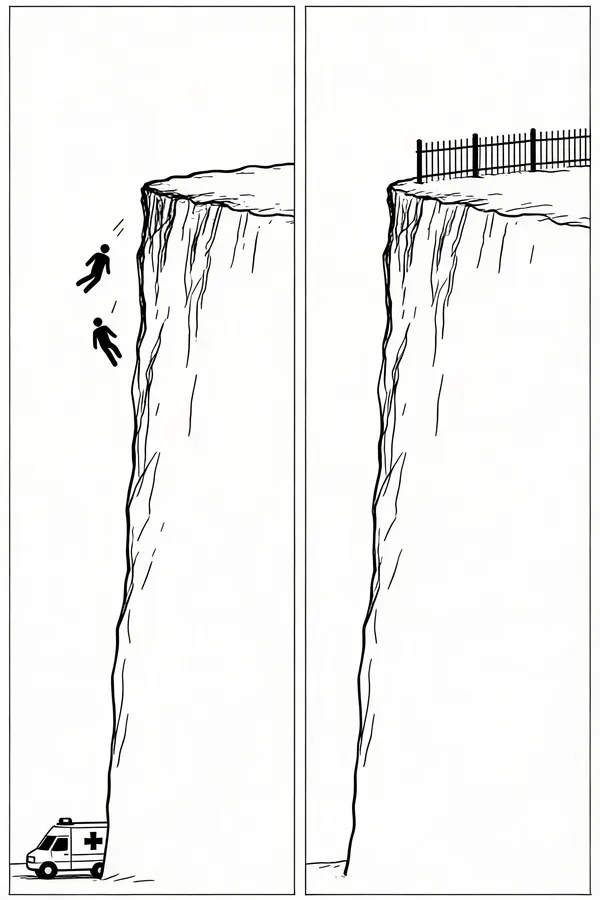
In another parable, a doctor stands by a river rescuing drowning people. More and more victims float downstream. Finally, someone walks upstream to understand why people keep falling in the river in the first place. Healthcare has increasingly learnt to account for human behaviour — and that same lesson should be applied to every human touchpoint.
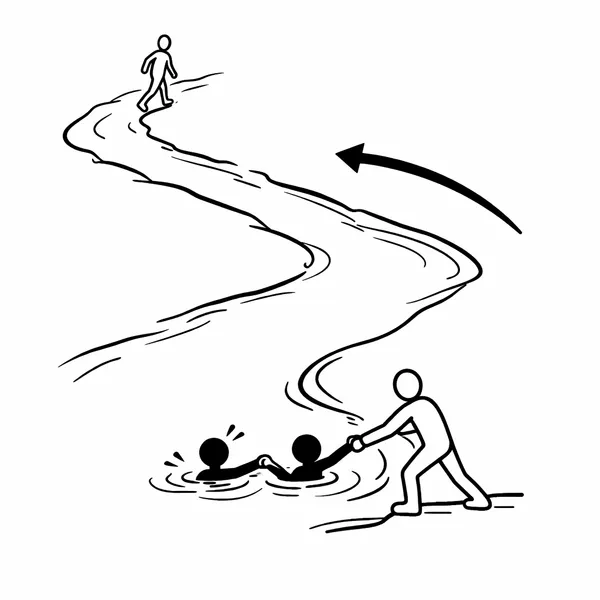
If human behaviour determines who reaches the cliff's edge, who falls in the river, then healthcare administrators are missing out wherever the science of human behaviour has not been factored into every communication channel. That includes digital signage inside clinics, and how telephone calls are handled.
A concrete example: the on-hold moment
Consider the patient who has called up and is waiting on hold. The healthcare administrator may feel that the best outcome for that patient comes from getting them to use the online portal or app — because they can immediately check symptoms, get 24/7 urgent care virtually, or make an appointment without waiting. To obtain that behaviour is a matter of behaviour engineering.
As illustration, here are five ways this could be worded:
- You can get easy access to the care you need via our secure online patient portal at URL, where you can schedule, reschedule or cancel your appointments, and more!
- Are you calling about an appointment, to check your symptoms, or to get urgent care? We can help you better online at URL.
- You can get easy access to the care you need via our secure online patient portal at URL, where you can schedule, reschedule or cancel your appointments, and more! Press # now and we'll text you the link.
- Are you calling about an appointment, to check your symptoms, or to get urgent care? It's faster online by visiting URL. Press # now and we'll text you the link.
- Are you calling about an appointment, to check your symptoms, or to get urgent care? We can help you the fastest online. Open your browser to URL. If you'd like us to text you the link now, please press #.
While these messages look similar, they perform vastly differently. The first is essentially useless. Only one has actually been engineered using the science of human behaviour.
Why this matters at every touchpoint
Marketers still tend to think that messaging revolves around motivation. But modern science reveals that motivation is often not the determining factor. The friction, the framing, the moment of delivery — these are the levers that shift behaviour at scale.
The same principle applies to digital signage in your waiting room, to the way your receptionist greets patients, to every touchpoint where patient behaviour is the outcome you're designing for.
But don't just take our word for this. When you work with Choice Catalyst, behaviour engineering methods like A/B testing on hold become possible — so you don't have to guess which message works. You measure it.